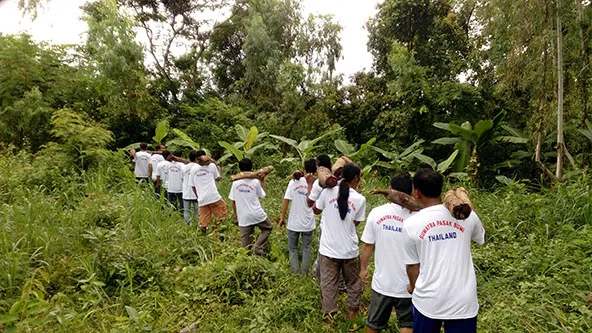
Most of what we do at PT Sumatra Pasak Bumi involves Tongkat Ali from Sumatra. But Butea superba does not grow in Indonesia. It is a Thai plant — a large vining legume that the Thais call Kwao Krua Daeng (กวาวเครือแดง, "Red Kwao Krua", Koj Liab in Hmong) — and it grows in the open-canopy deciduous forests of the Thai interior, mostly in the north and northeast. We got into it through years of working with Hmong hilltribe communities in Northern Thailand.
There actually are two Superba plants that are found mostly in North and Northeast Thailand. Butea superba and Butea monosperma. The superba is a creeper, the monosperma just a stunt tree.
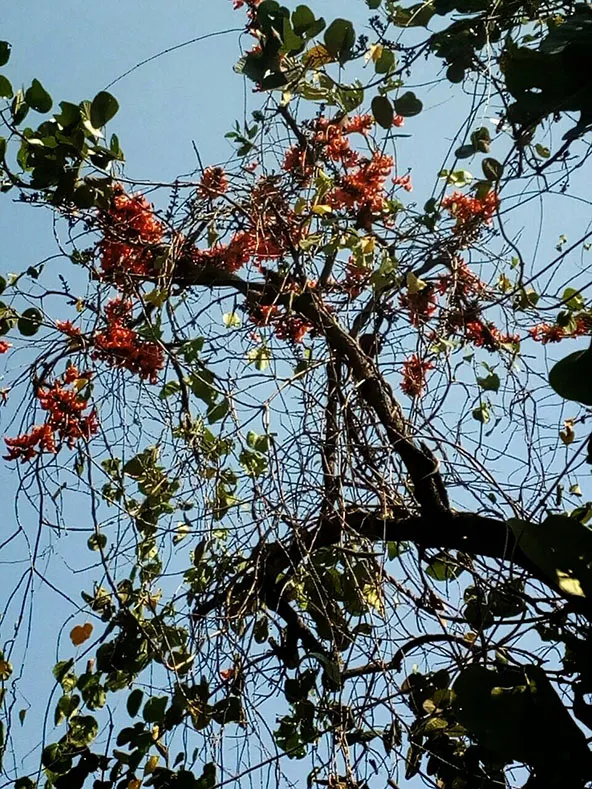
When I was touring Northeast Thailand (อีสาน) a few years ago with a Lao Hmong friend and fellow botanist, Kao Lis, we saw long rows of Butea monosperma trees along roads in Southern Surin (สุรินทร์) province. The tree is quite decorative, with its bright red flowers. The vine, Butea superba, is never used as a decorative plant, as it parasites other large trees for stationary support. The Butea monosperma tree does not produce a red sap like the Butea superba vine, and it doesn't have much use in ethnobotany.
We drove onwards by car into Cambodia... that was well before the 2025 Thai Cambodian border war. At that time, the Chong Chom (ช่องจอม) border crossing was the only one where one could enter Cambodia with a Thai car and drive anywhere in Cambodia. We did not come across and Butea species in Cambodia.
The plant
Butea superba is a member of the Fabaceae family — the legumes — which puts it in the same broad family as soybeans, lentils, and peanuts, though it does not look much like any of them. It is a climbing vine that uses forest trees as its support structure. During flowering season in the dry months, it produces bright red flowers in a shape locals describe as a parrot's beak, which makes it easy to spot from a distance even in dense canopy. That is how the Hmong collectors locate it.
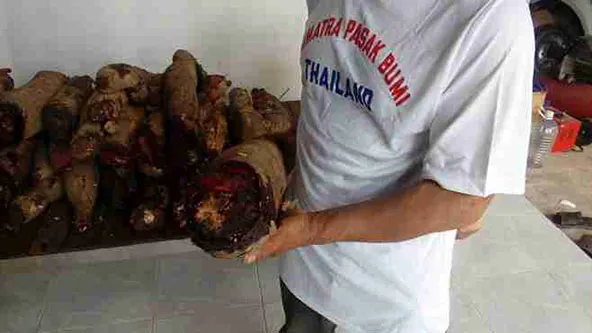
What gets harvested is the root tuber. These are large, irregular, starchy masses that can weigh several kilograms. When cut open, a dark reddish sap runs out — the Hmong describe it as bleeding, and the name "Red Kwao Krua" comes from this. There is no cultivation of Butea superba at commercial scale. Everyone selling it is drawing on wild collections, which puts a real ceiling on how much can be responsibly sourced.
| Taxonomic Rank | Classification |
|---|---|
| Kingdom | Plantae |
| Family | Fabaceae (Leguminosae) |
| Genus | Butea |
| Species | Butea superba Roxb. |
| Common Name | Red Kwao Krua / กวาวเครือแดง |
What we extract and why we standardize to 4% butein
The tubers contain a range of flavonoids and phenolic glycosides. The compound we standardize to is butein — chemically, 3,4,2',4'-tetrahydroxychalcone — a chalcone flavonoid that also gives the cut tuber its distinctive red color. Our extract is produced from wild-crafted Thai tubers and verified at 4% butein by HPLC.
Why butein specifically? A 2000 study by Roengsumran et al. published work on flavonoids from Butea superba and their activity against cAMP phosphodiesterase enzymes. cAMP phosphodiesterase inhibition is the same general mechanism that pharmaceutical PDE5 inhibitors work through, though the specificity and potency are different. Laboratory research has investigated various flavonoids in Butea superba, including butein. No clinical or physiological claims are made. The research is cited for chemical reference only. But they are why butein content is the number to pay attention to when evaluating any Butea superba extract.
| Specification | Detail |
|---|---|
| Source Material | Mature wild-crafted Thai tubers |
| Standardization | 4% Butein (HPLC verified) |
| Morphology | Concentrated fine powder |
| Extraction | Multi-stage, low-temperature process |
Traditional use in Thailand
In Thai traditional medicine, Butea superba has been used for a long time as a tonic. The traditional preparation was either honey-ball pills — the powdered tuber mixed with honey and rolled — or alcohol infusions, the tuber soaked in rice whiskey. Neither of those delivery forms controls for dose or compound concentration, which is the practical argument for a standardized extract. The ethnobotanical record is clear that this plant has a history of use in Thai traditional medicine as a general tonic. Traditional use does not imply any specific effect. That is where the traditional knowledge ends; it does not tell us which compounds are doing what or in what amounts.
The phytochemical profile of the tuber also includes butin, medicarpin, and various phytosterols alongside the butein. Low-temperature drying and multi-stage extraction is how we preserve those secondary compounds. High heat is fast and cheap but degrades flavonoids.
How Butea Superba relates to the other plants we sell
We are sometimes asked how Butea superba compares to Tongkat Ali. They are not interchangeable and not substitutes for each other. They are different plants from different regions (Sumatra vs. Thailand) with different chemical profiles. No claims are made about their effects in the human body. Some customers choose to use both; others use one or the other. That is a decision we leave to the buyer. We are a supplier of botanical extracts, not a clinic.
One distinction worth making: there is also a White Kwao Krua — Pueraria mirifica — which is an entirely different plant with different chemistry. The two are sometimes confused by name. Red Kwao Krua (Butea superba) and White Kwao Krua (Pueraria mirifica) share a region but nothing else relevant.
Practical notes
Testing: We test all batches at ISO-accredited third-party laboratories for heavy metals, pesticide residues, and microbial contamination. Northern Thailand is not a heavily industrialized region, and the forest collection areas are far from industrial soil contamination sources. We test regardless.
Supply constraints: There is no cultivation of Butea superba at commercial scale — this is not a situation likely to change soon, as the plant requires specific forest conditions to establish. Anyone selling it is drawing on wild collections. We work exclusively with the Hmong collectors we have had relationships with for years, and we do not overcommit on volume we cannot reliably source.
Regulatory Notice: