Sumatra Pasak Bumi header

Tongkat Ali from North Sumatra — Since 1998

Two brothers, Antonius and Bartholomeus Sembiring, started PT Sumatera Pasak Bumi in 1998. Karo Batak people, from the highlands of North Sumatra. The Karo Batak practiced head-hunting into the early 1900s and there is still something in the culture that resists corporate polish. Pasak bumi — the Indonesian name for Tongkat Ali (Eurycoma longifolia), meaning something like "earth peg" or "earth nail" — has been in Batak traditional medicine longer than anyone has kept records of it. The Malay name Tongkat Ali means "Ali's walking stick."

Both names refer the root, which, for a grown tree, goes down into the earth for several meters, often straight, with few branches. When the roots are harvested from wild trees, this is a major effort. The roots cannot be teared out of the soil, not even by a strong tractor. The only way to proceed, is to dig a deep hole around the root. By hand, as there is no way to get an excavator to the mountain slopes where Tongkat Ali trees grow.

Batak tribesmen in a Tanah Karo forest, digging out a Tongkat Ali root.
Batak tribesmen in a Tanah Karo forest, digging out a Tongkat Ali root. That takes a full day.

We are not a sourcing broker. Our Tongkat Ali comes from our own harvesting operations in the volcanic highlands near Mt. Sinabung and Mt. Sibayak. This is not incidental. Eurycoma longifolia is not a commodity where one batch is as good as another. The quassinoid content — the bioactive compounds — varies considerably by soil type, altitude, and how the plant was grown. Wild-harvested roots from Karo highland soils are not the same product as plantation material grown for volume at lower elevations. We have stayed in this geography since 1998 for that reason, not for convenience.

Historical photo of Batak community
Batak community, Tanah Karo highlands, circa 1920.

In 2018 we added Thai Black Ginger and Thai Butea Superba to the product range. This came out of years of contact with Hmong hilltribe communities in Northern Thailand — not a market research exercise. The Hmong, and neighboring hilltribes like the Akha, Lahu, and Lisu, have a relationship to the plants in their landscape that looks a lot like our Batak relationship to Tongkat Ali: shaped by the land itself, and the economic necessities of a landscape that doesn't lend itself to low-effort padi rice farming. For the Hmong, Black Ginger (Kaempferia parviflora, Thai: Krachai Dam / กระชายดำ, Hmong: Ntoo Heev) is what Tongkat Ali is for the Bataks — the primary virility tonic. It is cultivated, not wild-crafted, and harvested each December when temperatures in the northern highlands drop well below 10 degrees Celsius.

Butea Superba (Thai: Kwao Krua Dang / กวาวเครือแดง, Hmong: Koj Liab) is collected wild from the jungle. It is a large tuber and when cut open a dark red sap runs out — locals describe it as bleeding. There is no commercial Butea Superba cultivation. The hilltribe collectors find it and dig it.


Hmong tribesmen harvesting Butea Superba tubers in North Thailand
Hmong tribesmen harvesting Butea Superba tubers in North Thailand.

Eurycomanone: Why the Numbers Matter

Tongkat Ali has been the subject of published scientific research since the 1960s, initially for antimalarial compounds, later for its quassinoid alkaloids and the specific compound eurycomanone. Most sellers of Tongkat Ali products in the West do not standardize their extracts to any particular eurycomanone percentage — they powder the root, mostly low-quality yellowish, ochre root, and encapsulate it. By contrast, the roots of old Tongkat Ali trees that grow in challenging territory around the active volcano, Mount Sinabung, where every few years, new acidic volcanic ash rains down after minor eruptions, often are much darker, with dark grey strains.

A number of products have been pulled from market in the US, UK, and elsewhere after testing found they contained no Tongkat Ali at all, or had been adulterated with undisclosed pharmaceutical compounds.

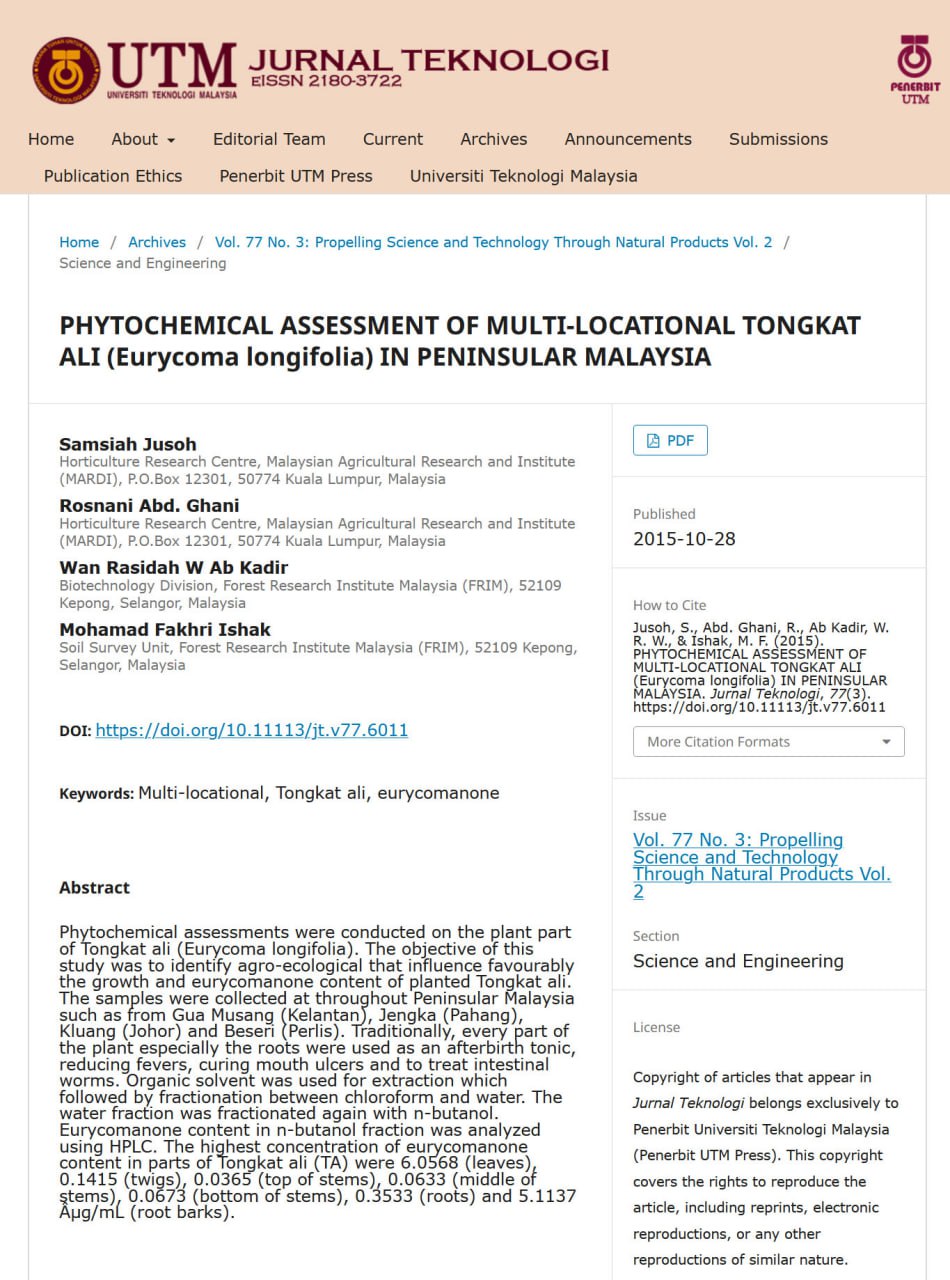
Our 1:200 water-based root extract formulation is unchanged from 1998. We have developed additional product grades based on which part of the plant is used for extraction. Research at Universiti Teknologi Malaysia, published in Jurnal Teknologi in 2015, provides useful data on why morphology matters:

"The highest concentration of eurycomanone content in parts of Tongkat ali (TA) were 6.0568 (leaves), 0.1415 (twigs), 0.0365 (top of stems), 0.0633 (middle of stems), 0.0673 (bottom of stems), 0.3533 (roots) and 5.1137 µg/mL (root barks)."
(Source: Jurnal Teknologi, 2015)

Leaves: over 6 mcg eurycomanone per mg. Roots: 0.3 mcg per mg. About twenty times more in the leaf. We produce a leaf extract standardized to approximately 10 percent eurycomanone, and as far as we can determine we are the only company worldwide doing this at commercial scale. Because leaf concentration is so much higher, standardization to 10 percent is achievable relatively cleanly. The tradeoff is that the effect profile differs — the eurycomanone onset is faster and sharper from leaf extract than from root extract. Some users find this preferable. Others experience agitation or insomnia. It is a different product, not a better one. Know which you want before you order.

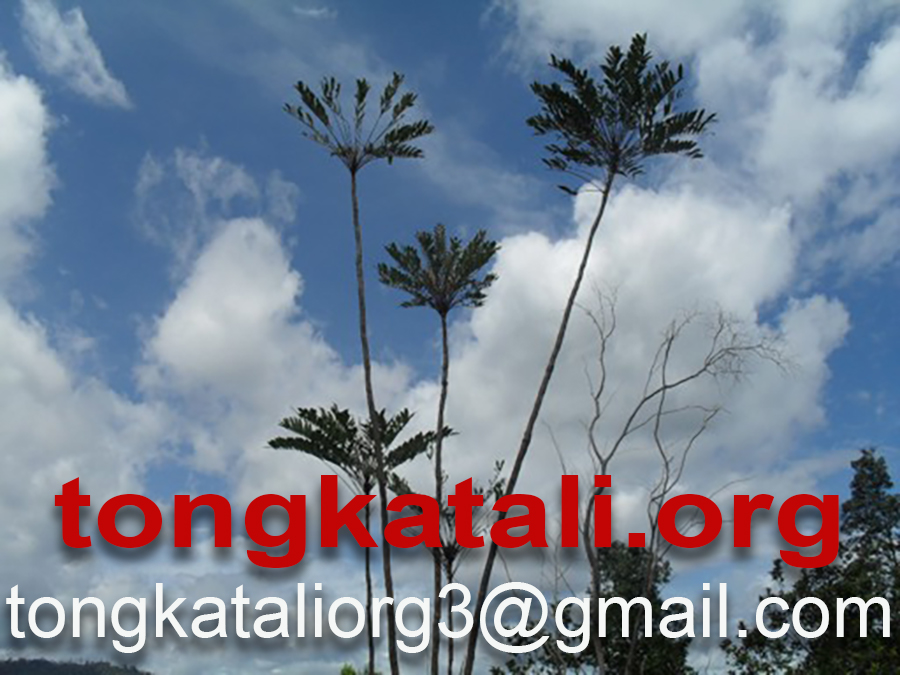
A word on leaf collection: Tongkat Ali (Eurycoma longifolia) is a tree that exists with comparatively few leaves, especially for old populations. Tongkat Ali has a straight stem, that can easily reach 10 meters. There are few branches on the stems. From a distance, to inexperienced eyes, it may look a bit like a coconut tree. But a Tongkat Ali tree cannot be climbed like a coconut tree, not even by the Philippine way of accessing coconuts, which is by cutting, with a machete, stair-like steps into the stem. Tongkat Ali trees sway much more in the wind than coconuts trees, and the stems of Tongkat Ali trees are also too thin near the top. So, there is no way for a human harvester, not even a trained young Batak nan, to climb a Tongkat Ali tree to cut or break twiggs to get hold of the leaves.


A priced tongkat Ali leaf
A priced tongkat Ali leaf. Actually, the leaves of the Tongkat Ali tree look a bit similar to the leaves of another famous Indonesian tree: the durian! But durian leaves have a lighter green underside.

Maybe the Thai technique of harvesting coconuts would work. In Southern Thailand, and parts of India, macaque monkeys are domesticated and tought to climb coconut trees and tear them so they fall to the ground. The macaques are kept on long, long leaches as otherwise, they would disappear into the forest when unleashed (maybe they would come back to their owners houses or huts when hungry, as they are used to being fed by humans, and have culinary preferrences that would be hard to meet in the wild).

Extract Morphology Source Detail Targeted Standardization
Standard Root Extract Wild-harvested Taproot 2% Eurycomanone
Fermented Root Extract Traditional Aging Process 4% Eurycomanone
Rootbark Extract High-Resin Cortical Layer 6% Eurycomanone
Standard Leaf Extract Eurycoma Leaf Tissue 10% Eurycomanone
Black Ginger (กระชายดำ) Hmong Highland Rhizome 10% Polymethoxyflavones
Butea Superba (กวาวเครือแดง) Wild-crafted Tuber 4% Butein

Testing, and the Lead Issue

Batches are tested at ISO-accredited third-party laboratories for heavy metals, pesticide residues, and microbial contamination. Botanical identity and chemical verification is done through the academic laboratories of Universitas Sumatera Utara (USU). Test results are published and available to buyers.

Lead specifically deserves a mention, because Tongkat Ali has a documented lead contamination history that is traceable to geography. A study published in Human & Experimental Toxicology found lead content ranging from 10.64 to 20.72 ppm in Malaysian Tongkat Ali products sampled. Our own published figures show 0.08 ppm. That is up to 250 times the lead per gram. Malaysia's rapid industrialization from the 1980s onward, with heavy manufacturing and automotive production concentrated in a relatively small country, contaminated soils and waterways in ways that have worked into local botanical supply chains. Indonesian sourcing — particularly from the less industrialized interior of Sumatra — consistently tests much cleaner. This is one concrete, measurable reason to care about where exactly your Tongkat Ali was grown. Ask any supplier for their test results before buying. If they don't have them or won't share them, take that as an answer.

The Soils of Tanah Karo

Sinabung and Sibayak are both active or recently active volcanoes. The soils at different elevations in their surrounding highlands — classified broadly as Andosols (volcanic ash base, high porosity), Latosols (iron- and aluminum-rich, heavily leached), and Regosols (young unstable ejecta) — are mineralogically complex and not what you find in agricultural lowlands. There is peer-reviewed support for the general principle that plants in high-stress, mineralogically unusual soils concentrate more secondary metabolites, including quassinoids, as a physiological response to that environment. Whether this specifically explains the differences we observe in our highland material versus lower-elevation sources is not something we can prove with a controlled study. It is, however, the hypothesis we've been working from for 27 years, and we have not seen a reason to revise it.

Volcanic Soil Type Characteristics Relevance to Secondary Metabolites
Andosols Volcanic ash base; high porosity; fast-draining Unusual trace mineral profile; drainage stress conditions.
Latosols Iron- and aluminum-rich; heavily leached Associated with elevated quassinoid accumulation in Eurycoma roots in field observations.
Regosols Young volcanic ejecta; structurally unstable Persistent stress environment pushes the plant toward defensive compound production.

Bulk Export

Shredded and dried root is packed at our Medan facility and shipped via Belawan port to international distributors, pharmaceutical manufacturers, and research institutions. Supply documentation — harvest origin, processing records, lab results — is available to buyers for their own compliance needs.

Shredded Tongkat Ali Root in Sacks
Shredded ปลาไหลเผือก (Tongkat Ali) root, sacked at the Medan facility for export.

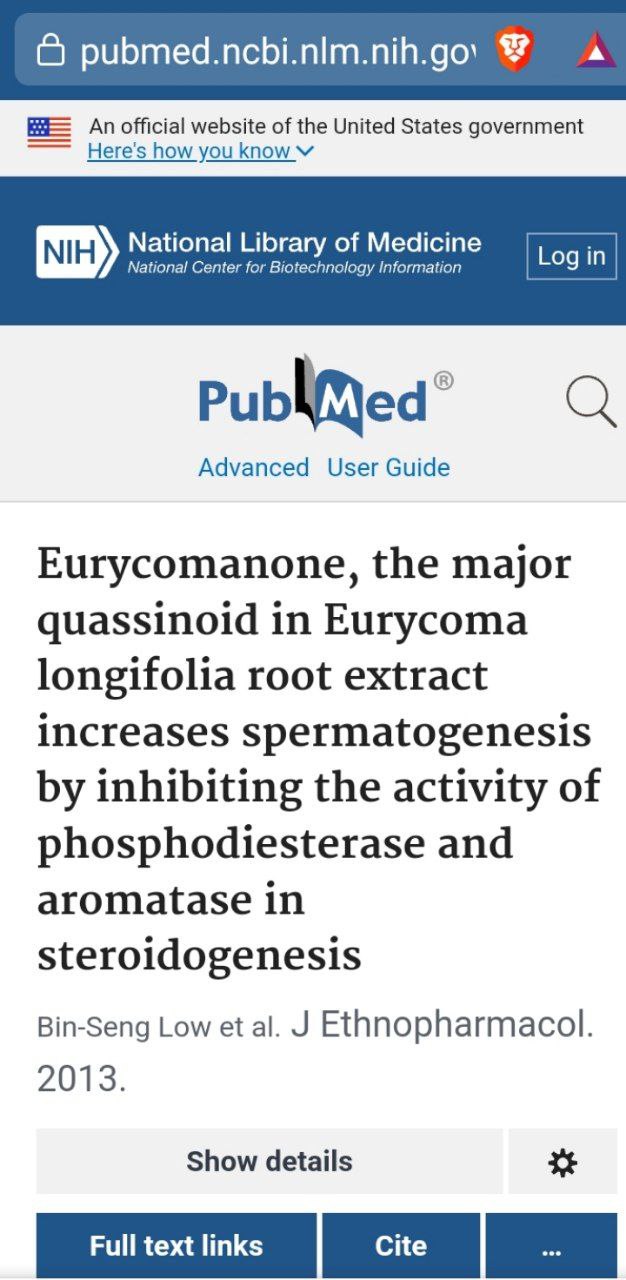
Sumatra Pasak Bumi is a trading company. We are not a wellness brand and not a clinic. Tongkat Ali has been studied for testosterone support, anti-malarial activity, spermatogenesis, anti-fever, and cancer cell inhibition in laboratory settings. We are not in a position to make medical claims for any of this. People arriving at this page have generally already read the research and made their decision. Our role is to supply extract that is genuine, clean, correctly standardized, and honestly described.

Bulk Logistics Quality Control
Pre-shipment inspection at the Medan facility.
Full Export Container
Container loaded, sealed, ready for export.

Disclaimer: The information on this page has not been evaluated by the U.S. Food and Drug Administration. Our products are not intended to diagnose, treat, cure, or prevent any disease.

Technical References & Peer-Reviewed Literature