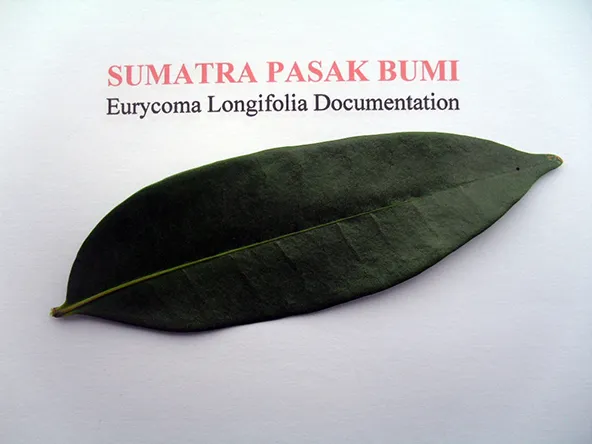
The scientific name is Eurycoma longifolia Jack. Family Simaroubaceae. A tree that grows across Malaysia, Indonesia, Vietnam, Cambodia, Myanmar, Laos, and Thailand. While it grows throughout Southeast Asia, Tongkat Ali is culturally significant only in Malaysia, Indonesia, and Singapore. Indonesia has by far the largest stock.
We are in Indonesia, and locally, we call it Pasak Bumi. I am a botanist, who has studied at the University of North Sumatra. I have traveled extensively throughout Southeast Asia. Sure, when I meet botanists in Hanoi or Chiang Rai, they know Eurycoma longifolia. But if I talk to an ordinary man in Hue or Chiang Mai, they typically have little awareness of the plant. On the other hand, every Batak man knows Pasak Bumi.
As a botanist, I am an exception in my clan and in Batak society. Sure, Batak men and women are great practitioners of ethnobotany. Everybody here believes in the magic of Pasak Bumi, or of herbal concoctions (our jamu), but when young Batak men choose an academic career, law is the most likely. In Indonesia, among criminal trial lawyers, Bataks are vastly overrepresented, considering the small percentage that our ethnicity makes up in the Indonesian population overall.
As a scientifically educated person, I can say it has nothing to do with it (until there is definite clinical proof), but if you ask ordinary Batak men, or Batak criminal trial lawyers, for that matter, they may pound their chest and proclaim: "Batak Pasak Bumi!" Traditional belief associates the plant with male vitality, but this page makes no scientific claims. Batak criminal lawyers aren't softies. Every cultivated Javanese will agree.
So much for storytelling. Now back to the science.
The whole Eurycoma longifolia tree has documented traditional uses, not just the root. Leaves, root bark, taproot -- each has its own record in the ethnobotanical literature across different countries and communities. Yes, in previous times, Tongkat Ali was used to treat diseases... and sure, if I visit my relatives in the Batak villages, I meet many elders who distrust professional modern medicine and instead cure their ailments with herbals. Note: this is not our official company position. We do not sell Tongkat Ali as a treatment for any disease; this page does not make recommendations for use. We are a supplier of botanical extracts, not a clinic.
Scientific research on Eurycoma longifolia goes back to the 1960s, when the plant first attracted attention for antimalarial compounds. From there the research expanded into phytochemistry, pharmacology, and toxicology. There are several hundred published papers indexed on PubMed and Google Scholar. Any claim about what this plant does, or does not do, that is not backed by a published study is just an opinion. Including ours. We sell extract. We are not a research institution. So rather than summarize the science ourselves, we point to where it can be read directly, in the references section at the foot of this page.
My connection to this landscape
I am a botanist by training and I have spent a lot of time in the Karo highlands of North Sumatra, where Sumatra Pasak Bumi has been sourcing since 1998. I also have family reasons to know this landscape well. My connection to the company is personal: I married into the Sembiring family, the founders. But my interest in the botany of this region predates that, and what I write here reflects field observation over many years, not company promotion.
The highlands of Tanah Karo sit in the shadow of two active or recently active volcanoes, Sinabung and Sibayak. Sinabung in particular has been intermittently erupting since 2010 and is still considered active. This is not a stable agricultural landscape in the way that lowland Java is stable. The soils are geologically young and mineralogically unusual: classified broadly as Andosols from volcanic ash deposition, Latosols in the more heavily leached iron- and aluminium-rich zones, and Regosols on younger ejecta slopes. None of these are the kind of rich, deep, settled soils that plantation agriculture prefers. They drain fast, they are chemically complex, and they put plants under persistent low-level mineral stress.
There is peer-reviewed support for the general principle that plants growing in high-stress, mineralogically unusual soils accumulate more secondary metabolites as a physiological defence response. Quassinoids, the compound class that includes eurycomanone, are secondary metabolites. The working hypothesis, held since the company's founding, is that highland volcanic sourcing produces material with higher quassinoid accumulation than lowland or plantation alternatives. This is not something we can prove with a controlled trial. But it is the hypothesis we have operated on for 27 years, and field observations of our material versus other sources have not given us reason to abandon it.
Wild harvested, not plantation
Eurycoma longifolia is not a crop. It grows wild in the forest understorey, slow-maturing, and it does not respond well to the conditions of managed cultivation. The roots we work with come from trees that are at minimum ten years old, typically older. Younger material has lower quassinoid accumulation; this is documented in the research literature and consistent with what we observe in the field. The Karo Batak harvesters who supply us know the old-growth areas. That knowledge is not written down anywhere. It is passed on within communities that have been living in and working with this landscape for generations.
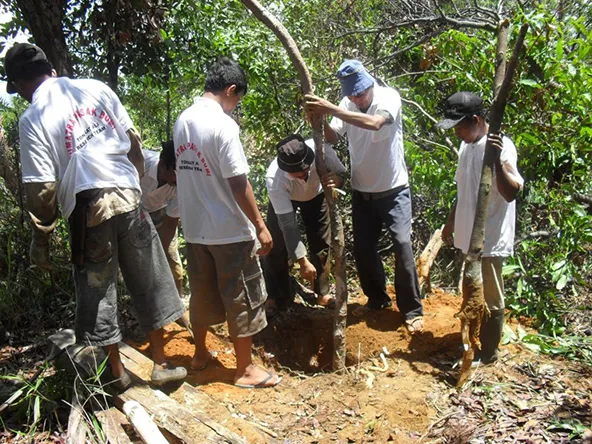
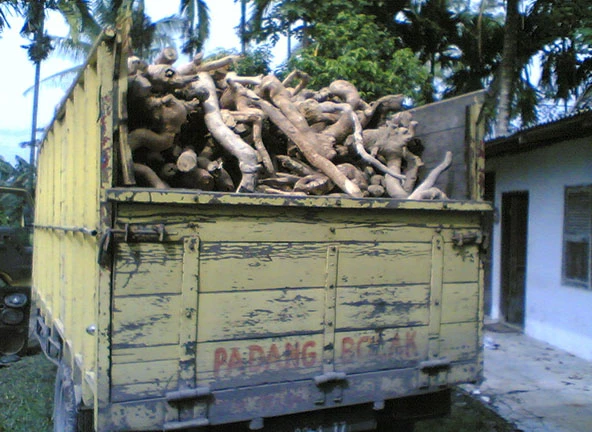
Harvesting mature Eurycoma longifolia is hard work, and I say that as someone who has watched it done, not as someone who has done it himself. The taproot goes straight down, several meters into the ground. You cannot pull it out. The only method is to dig a pit around the tree by hand, deep enough to expose a workable length of root, then cut what you need. A full-grown tree is a full day of digging for one man. This is why genuine old-growth wild-harvested Tongkat Ali cannot be cheap. Anyone selling it at commodity prices is not selling the same thing.
A word on leaf collection, because it explains why we are likely the only producer of commercial-scale Tongkat Ali leaf extract. Tongkat Ali is a tree that exists with comparatively few leaves, especially for old populations. It has a straight stem that can easily reach 10 meters, with few branches. From a distance, to inexperienced eyes, it may look a bit like a coconut tree. But a Tongkat Ali tree cannot be climbed like a coconut tree, not even by the Philippine way of accessing coconuts, which is by cutting stair-like steps into the stem with a machete. Tongkat Ali trees sway much more in the wind, and the stems are also too thin near the top. So there is no way for a human harvester, not even a trained young Batak man, to climb a Tongkat Ali tree to cut or break twigs to get hold of the leaves.
Maybe the Thai technique of harvesting coconuts would work. In Southern Thailand, and parts of India, macaque monkeys are domesticated and taught to climb coconut trees and tear them so they fall to the ground. The macaques are kept on long leashes because otherwise they would disappear into the forest when unleashed, though they may come back to their owners when hungry, having culinary preferences that are hard to meet in the wild.
Eurycomanone by plant part
Eurycomanone is a quassinoid, a bitter tetracyclic compound, and the most studied of the roughly 150 quassinoids identified in Eurycoma longifolia to date. When buyers or researchers refer to "standardized Tongkat Ali extract," the number they are usually referring to is the eurycomanone percentage. It is measurable with reasonable precision by HPLC, which gives it value as a standardization marker. No claims about human physiological effects are made.
Its concentration differs substantially across morphological parts of the plant. Research at Universiti Teknologi Malaysia, published in Jurnal Teknologi in 2015, documented the actual figures:
"The highest concentration of eurycomanone content in parts of Tongkat ali (TA) were 6.0568 (leaves), 0.1415 (twigs), 0.0365 (top of stems), 0.0633 (middle of stems), 0.0673 (bottom of stems), 0.3533 (roots) and 5.1137 µg/mL (root barks)."
-- Jurnal Teknologi, 2015
Root bark runs about 5.1 µg/mL. Leaves run about 6.1 µg/mL. Standard root runs 0.35 µg/mL. The root bark has roughly 14 times the eurycomanone concentration of the taproot, and the leaf about 17 times more. This is why we produce three separate extract grades from three separate plant parts. They are not the same product and do not perform the same way.
| Plant part | Native eurycomanone | Standardization target |
|---|---|---|
| Taproot | ~0.35 µg/mL | 2% eurycomanone |
| Root bark | ~5.1 µg/mL | 6% eurycomanone |
| Leaf | ~6.1 µg/mL | 10% eurycomanone |
Root bark vs. root wood (xylem)
The root itself is not chemically uniform. It consists of two distinct tissues: the root bark (the periderm, cork, phloem, and outer cortex) and the inner root wood, or xylem (the dense woody core that remains once the bark is removed). Despite this, most commercial Tongkat Ali products, ours included in the standard root grade, are manufactured from the woody xylem rather than the bark. The reason is stability, not chemistry, and it is worth explaining why.
As the table above shows, root bark measured at roughly 5.11 µg/mL of eurycomanone against 0.35 µg/mL in the woody root, a roughly 14-fold difference. Beyond eurycomanone, the bark carries higher concentrations of other quassinoids, canthin-6-one alkaloids, β-carboline alkaloids, phenolic compounds, and tannins. The xylem, by contrast, is dominated by cellulose, hemicellulose, and lignin: structural tissue built for water transport and mechanical support, not chemical defence.
| Compound class | Root bark | Root wood (xylem) |
|---|---|---|
| Eurycomanone | Very high | Low |
| Other quassinoids | High | Moderate |
| Canthin-6-one alkaloids | High | Moderate |
| β-Carboline alkaloids | High | Moderate |
| Phenolic compounds | High | Low |
| Tannins | High | Very low |
| Cellulose | Low | Very high |
| Hemicellulose | Moderate | High |
| Lignin | Moderate | Very high |
| Structural fibre | Low | Very high |
The bark deteriorates quickly once a root is harvested or dies. It is more vulnerable to microbial decomposition, moisture loss, and physical damage in handling and storage. The xylem is mechanically stronger, resists fungal and bacterial degradation, stores for extended periods, and tolerates transport and processing with far less loss. So producers frequently strip the bark before drying and processing, trading a richer compound profile for a raw material that survives the supply chain intact. This is also why we offer a separate root bark extract, standardized to 6% eurycomanone, alongside the standard root grade — for buyers who specifically want the bark's chemical profile and are prepared for the handling it requires.
The leaf extract standardized to 10% eurycomanone is a product we believe we are the only company producing at commercial scale. Because the leaf starts with a higher measured eurycomanone concentration than the root, reaching 10% standardization is achievable without extreme processing steps. The chemical profile differs from root extract due to the higher concentration per gram. This is a chemical distinction, not a claim about effects.
There is also a logistical reason extraction happens at the source rather than overseas. Dried Tongkat Ali leaves are extremely light and voluminous. A standard shipping container can hold roughly 20 to 25 tonnes of dense material, but dried leaves would fill it long before approaching that weight. You would be paying container freight rates to ship mostly air. Concentrating the material locally by processing into extract reduces bulk by orders of magnitude and makes export viable.
What genuine extract tastes like
The "bitterness" of finished extract is a reliable indicator of quality. The taste is described as "bitter" for lack of a better word. Tongkat Ali isn't bitter like dark chocolate. Tongkat Ali just has an very unpleasant taste, and texture. If one knows this mouthfeel of Tongkat Ali, really everybody can identify it. Eurycomanone and the other quassinoids are intensely "bitter" compounds; this is, in fact, why the plant produces them, as a deterrent to insects and browsers. An extract that is mild-tasting or nearly flavourless has not retained those compounds in meaningful concentration. Genuine high-eurycomanone extract is unpleasant to taste neat. That is not a flaw. It is how you know it is real.
Research references
The most useful single starting point is the 2016 review by Rehman, Choe, and Yoo in Molecules. It covers ethnobotany, traditional uses by plant part, the phytochemistry across all six compound classes, pharmacological effects with their evidence levels, and the toxicology data from animal and human studies. It is open access, meaning free to read without a journal subscription. The reference list in that paper is itself a map of the broader literature. The following references are cited for academic and botanical purposes only. They do not constitute claims that our products produce any of the effects described in the studies.
For how eurycomanone interacts with the enzymes involved in testosterone production, specifically phosphodiesterase and aromatase, the most cited paper is:
Heavy metal contamination in commercial Tongkat Ali products has been documented in the research literature. The relevant paper is by Ang et al. Our own batch test results are on the certificates page.
Disclaimer: The information on this page has not been evaluated by the U.S. Food and Drug Administration. Our products are not intended to diagnose, treat, cure, or prevent any disease.