
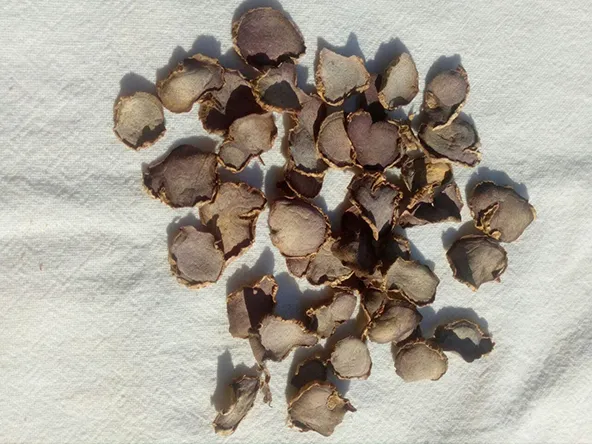
Kaempferia parviflora, called Krachai Dam (กระชายดำ) in Thai and Ntoo Heev in Hmong, is a rhizomatous plant in the Zingiberaceae family. Despite sharing a family with common ginger and galangal, it is a distinct genus. The interior of a fresh rhizome is a deep purple-black — striking, and immediately distinguishable from any other plant in the family. That pigmentation comes from a class of flavonoid compounds called polymethoxyflavones, or PMFs.
Taxonomy
| Taxonomic Rank | Classification |
|---|---|
| Kingdom | Plantae |
| Family | Zingiberaceae |
| Genus | Kaempferia |
| Species | Kaempferia parviflora Wall. ex Baker |
| Thai name | Krachai Dam / กระชายดำ |
| Hmong name | Ntoo Heev |
Cultivation and origin
Unlike Tongkat Ali (Eurycoma longifolia) and Butea Superba, which are wild-harvested, Black Ginger is cultivated. The Hmong hilltribe communities of Northern Thailand — farming at elevations above 1,000 meters, in the highlands north and east of Chiang Rai — have been growing it for generations. It is a seasonal crop. The rhizomes are dug in December, after the highland cool season sets in and temperatures at altitude can drop below 10 degrees Celsius. Harvesting outside this window produces material with lower PMF concentrations.
Our supply relationship with Hmong cultivators in this region predates our formal product launch in 2018. The Hmong, like the Karo Batak of North Sumatra with Tongkat Ali, have a detailed accumulated knowledge of how to grow, harvest, and store this plant that does not exist in any written manual. That knowledge comes from continuous cultivation practice in a specific landscape. We source exclusively from those communities.
Polymethoxyflavone chemistry
PMFs are methoxy-substituted flavones — flavonoids in which one or more hydroxyl groups have been replaced by methoxy groups. This structural difference makes them more lipophilic than most flavonoids. The primary marker compound in Kaempferia parviflora is 5,7-dimethoxyflavone, but the plant contains a broader PMF spectrum including 3,5,7-trimethoxyflavone and several others. Published research has focused on the total PMF fraction rather than isolating a single compound, which is why standardization targets total PMFs rather than a single molecular species.
Laboratory studies have investigated various PMF compounds. The body of peer-reviewed literature includes work on the chemistry of Kaempferia parviflora.
Our extract — 10% PMF standardization
| Specification | Detail |
|---|---|
| Source material | Kaempferia parviflora rhizomes, Hmong highlands, Northern Thailand |
| Harvest season | December (cool season, high altitude) |
| Standardization | 10% Polymethoxyflavones (PMF), verified by HPLC |
| Primary marker | 5,7-dimethoxyflavone |
| Appearance | Deep purple to dark brown fine powder |
| Excipients | None — extract only, no fillers or flow agents |
| Shelf life | 3 years, sealed, cool and dry storage |
Raw rhizome powder varies batch to batch. Two shipments of dried Kaempferia parviflora from different farms or different harvest years can differ in PMF content. Standardization means concentrating the extract and testing every batch by HPLC to confirm the PMF percentage before it leaves production.
Traditional use
The Hmong of Northern Thailand have used Black Ginger as a tonic — traditionally steeped in rice wine or prepared as a decoction — for longer than recorded history in the region. Other highland communities, including Akha and Lisu groups, have similar uses for it. Traditional use does not prove mechanism, but it provides a long empirical record that has given researchers reason to investigate the plant's chemistry.
The PMF research has identified various compounds in the plant.
Practical notes
Why does the harvest season matter? Cold stress at altitude appears to correlate with PMF content in the rhizome. The Hmong farmers who grow this plant have refined their timing over generations — harvesting in December, after the rains finish and highland temperatures drop, sometimes below 10 degrees Celsius. Outside that window the rhizomes are either immature or beginning to decline in quality. Consistent year-round supply depends on proper storage of each season's harvest rather than continuous harvesting through the year.
Why standardized extract rather than raw powder? Raw rhizome varies considerably batch to batch — different farms, different years, different soil conditions all shift PMF concentration. Our 10% PMF specification is tested by HPLC to ensure chemical consistency.
Shelf life and storage: Three years, sealed, cool and dry. The extract contains no fillers or excipients, which makes it stable but moisture-sensitive. Once a container is opened, keep it sealed between uses and away from heat. High-humidity environments require extra attention.
Where to read the primary research: PubMed and Google Scholar both index the Kaempferia parviflora literature. Reading primary sources is more informative than any product page summary, including this one.
Shop our 10% PMF standardized extract